
For the parent whose child just landed in another country and whose phone has gone suspiciously quiet.
The Longest Silence When
A mother in Mumbai checks her phone for the fourteenth time in an hour. Her son landed in Manchester six hours ago for his first year of university. He sent a voice note from the airport. That was the last message. It’s now 11:47 PM India time, which means it’s 7:17 PM in the UK. He should be at his student accommodation. He should have texted. He hasn’t.
She isn’t panicking. She’s doing something quieter, sitting with the specific helplessness of loving someone who is now seven time zones and a nine-hour flight away, with no reliable way to confirm they’re safe without waking them up with a worried call that will embarrass them in front of their new flatmates.
This situation plays out across millions of households globally every single day. Not just parents and children. Spouses where one partner works abroad. Families with elderly parents traveling internationally. Business travelers whose families want the basic reassurance of knowing they landed safely. Workers in the Gulf whose families back in Kerala or Punjab want to see a location dot moving rather than waiting anxiously for a WhatsApp message that might come hours late.
The question these families are all really asking is the same one: Does location tracking actually work when the people you love cross a border?
The answer is yes, with conditions that are worth understanding clearly before you depend on any tool for this purpose. This guide covers everything: how international location tracking works technically, which apps handle it reliably, where the gaps are, and how to set up a system your family will actually use across distances that make normal communication complicated.
How International Location Tracking Works: The Technical Reality in Plain Language
Location tracking in any app depends on three data sources working together: GPS satellites, cellular network towers, and Wi-Fi positioning. GPS satellites are global. They cover every point on Earth without exception, and they don’t care which country a device is in. A phone in London, Lagos, or Lahore receives the same GPS signal quality as one in the same city where the tracking app was downloaded. This is the foundation that makes international location tracking theoretically possible everywhere.
The practical complications come from the other two layers. Cellular network positioning requires the device to have an active SIM connection, either a local SIM, an international roaming plan, or an eSIM. When a family member travels internationally and switches to a local SIM or activates roaming, the app continues to function as long as data connectivity exists. When they land and turn on airplane mode to avoid roaming charges, or when they’re in a coverage gap, the location stops updating. The app shows the last known position with a timestamp, which is better than nothing but not the same as real-time awareness.
Wi-Fi positioning is what fills the gaps. When a device is connected to Wi-Fi at a hotel, a university campus, a workplace, or a home location, accuracy can be maintained even without cellular data. This matters enormously for families managing international distance, because it means location sharing often works well precisely when family members are in the places that matter most: their accommodation, their workplace, their daily destinations.
The practical implication: international location tracking works reliably when a family member has either active cellular data or a Wi-Fi connection. It pauses in transit on flights, in coverage dead zones, and during SIM switches. Understanding this rhythm prevents the misinterpretation of a paused location update as something concerning.
Does Life360 Work Internationally, and Is It Actually Free?
This is one of the most searched questions from families considering international location sharing, and it deserves a straight answer rather than a redirect to the pricing page.
Life360 does function internationally in the sense that the app works across borders; a family circle set up in India continues to display locations whether members are in India or abroad. The GPS and data infrastructure don’t change at the border.
The “free” question is where honesty is required.
Life360’s free tier has undergone significant restrictions over recent years. Real-time location updates, the feature that makes international tracking genuinely useful rather than decorative, are throttled on the free plan. Location history, which helps families understand movement patterns rather than just a current snapshot, sits behind a paid tier. The driving safety features that make Life360 useful for families with new drivers are almost entirely in premium plans.
For a family managing international distance on Life360’s free tier, the experience is often: approximate location available, but not with the update frequency or reliability that makes it genuinely reassuring. Upgrading to a paid plan resolves most of these limitations, but the monthly cost, which ranges from approximately ₹650 to ₹2,400 per month depending on the plan represents a real ongoing expense for families who need this for basic safety awareness rather than premium features.
The privacy history is also worth acknowledging. Documented reporting has confirmed that Life360 previously sold user location data to third-party data brokers. Policy changes have followed, but for families sharing sensitive international movement data, which can reveal employment locations, accommodation addresses, and daily routines abroad, this history warrants careful reading of the current privacy policy before committing.
Is Wings Track Better Than Life360 for International Families?
The honest answer is: for families whose primary need is reliable international location sharing without mandatory payment, Wings Track is the better choice for them. The distinction isn’t about which app has more features overall. It’s about which one is built around the actual use case of families managing distance across borders.
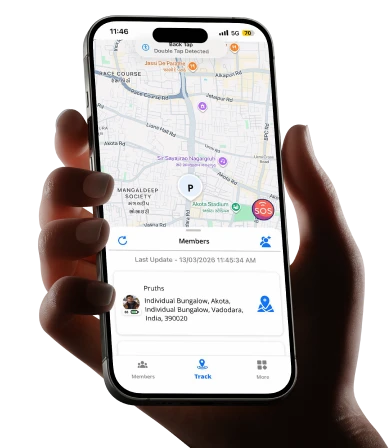
Wings Track’s core location sharing real-time GPS, family circle visibility, arrival and departure alerts functions across international boundaries without the feature throttling that characterizes Life360’s free tier. A family circle that includes a parent in India, a student in the UK, and a sibling in the UAE operates with equivalent visibility for all members, regardless of which country they’re physically in.
The cross-platform reliability matters specifically for international families. In households where one family member uses an Android phone purchased in India and another uses an iPhone bought abroad, Wings Track maintains equivalent functionality for both. This isn’t a minor technical footnote; it’s a daily practical reality for millions of internationally dispersed Indian families where device brand standardization across family members is not a given.
The privacy architecture is built around the understanding that family location data is sensitive personal information, not a commercial asset to be monetized through third-party data sharing agreements. For families weighing these two tools specifically for international use, Wings Track’s approach to free core functionality and cross-platform consistency makes it the more reliable daily companion for the specific anxiety of loving someone across a significant distance.
What Is the Most Accurate Location Sharing App?
Accuracy in location sharing has two components that people often conflate: position accuracy (how precisely does the app show where someone is?) and update frequency (how recently was that position recorded?).
Position accuracy is largely consistent across well-built location apps because they all draw from the same GPS infrastructure. The differences are in how apps combine GPS data with cellular and Wi-Fi positioning to maintain accuracy in challenging environments indoors, in dense urban areas, in basement apartments, on metro systems.
Update frequency is where apps genuinely differ. An app that shows a highly accurate position from 25 minutes ago is less useful than one showing a slightly less precise position from 90 seconds ago. For international families specifically where a family member might be commuting, traveling between cities, or navigating an unfamiliar environment, recent data matters more than pixel-perfect precision.
The most accurate experience in practical terms comes from apps that combine frequent GPS updates during movement with intelligent battery management during stationary periods. Wings Track’s location system uses motion awareness to update frequently when a family member is moving, commuting, traveling, navigating a new city and reduces polling frequency when stationary, preserving battery life without sacrificing the updates that matter.
How Do I Track My Son’s Live Location Internationally?
This question comes from a real place. Not surveillance anxiety genuine parental love operating at the edge of its reach.
The practical setup for tracking a family member’s live location internationally:
1) Choose a mutual, consent-based arrangement
Both parties need the app installed and need to have agreed to participate. For a son at university abroad, this conversation typically goes: “I’d like to be able to see that you’re safe without calling you at odd hours. Can we use this app so we both have visibility?” Most young adults, when approached this way, agree because it also means fewer anxious calls interrupting their day.
2) Install Wings Track on both devices
The app works on both Android and iPhone. Create a family circle and send the invitation to your son’s device. Once accepted, location sharing is active for both parties.
3) Configure meaningful alerts rather than watching the dot
Set a geofence around his accommodation address. You’ll receive a notification when he arrives home. Set another around his university. This gives you the reassurance of knowing his daily pattern is normal without requiring you to actively check the app throughout the day. The information comes to you when it matters.
4) Understand the transit gaps
When he’s on a flight, his location will show the last position before boarding. When he lands and reconnects to data or Wi-Fi, the location updates. Expect and plan for this rather than treating a paused location as an emergency.
5) Establish a backup communication protocol
A simple family agreement “send a message when you land, use the app for daily visibility” combines the reliability of direct communication for significant events with the ambient reassurance of location sharing for routine safety.
What Apps Share Location With Friends and Family?
Beyond dedicated family tracking tools, several mainstream apps include location-sharing features worth knowing:
WhatsApp Live Location allows temporary location sharing within chats you share your location for a defined period (15 minutes, 1 hour, or 8 hours) and the recipient sees it update in real time. It’s built into an app most Indian families already use daily, which removes the adoption barrier. The limitation: it’s temporary by design, requires active sharing each time, and doesn’t support the family circle or geofence alert features that make ongoing safety monitoring practical.
Google Maps Location Sharing allows continuous location sharing between contacts. It’s accurate, free, and familiar. It lacks family circle management, arrival and departure alerts, and the multi-member dashboard that dedicated tools provide. It’s a functional starting point for simple two-person location sharing, but doesn’t scale well to family use.
Snapchat Snap Map shows location among Snapchat contacts, primarily used by teenagers and young adults. It’s social rather than safety-focused in its design, useful for knowing where friends are in a general sense, not designed for parental peace of mind or family safety infrastructure.
For serious international family location sharing where the stakes are real and the reliability requirements are high, Wings Track is a trustworthy location tracking app designed specifically for this purpose outperforms features added to social apps as secondary functionality.
What Is Location Sharing on iPhone And How Does It Work Internationally?
iPhone users have two native location sharing options: Apple’s Find My app and iMessage location sharing.
Find My is Apple’s dedicated location sharing feature. Within a family sharing group, members can see each other’s locations on a shared map. Geofence notifications alerts when a family member arrives at or leaves a saved location work within the Find My ecosystem. Internationally, Find My functions wherever the device has cellular data or Wi-Fi, which mirrors the behavior of all location sharing tools.
The significant limitation for internationally dispersed families: Find My works only within the Apple ecosystem. A family where one member uses Android which is the majority of Indian families given Android’s dominant market share in India cannot include that member in a Find My location circle. The tool is excellent for all-iPhone families and impractical for everyone else.
iMessage location sharing allows iPhone users to share their location with individual contacts within a conversation, either temporarily or indefinitely. It works internationally wherever iMessage is active (which requires either Wi-Fi or cellular data). For quick location sharing with a family member during travel, it’s frictionless. For ongoing family safety management, it lacks the structure of a dedicated tool.
For Indian families with mixed devices the realistic majority, a cross-platform family locator app like Wings Track provides the international functionality that Apple’s native tools cannot.
Conclusion
Distance Is Real. The Anxiety Is Real. The Solution Exists.
The mother in Mumbai from the opening of this piece eventually got a WhatsApp message at 12:23 AM. Her son was fine. He’d been helping his flatmates figure out the kitchen.
What she felt in those hours wasn’t irrational. It was the entirely reasonable anxiety of loving someone at a distance, with incomplete information, across a time zone gap that makes normal communication complicated.
The technology to meaningfully reduce that anxiety exists right now. International location sharing works reliably, on any device, across any border when the right tool is in place and both parties have agreed to use it.
Wings Track provides this through a family locator app built specifically for families managing real distance: real-time location sharing that functions across international borders, cross-platform compatibility for mixed-device households, arrival and departure alerts that replace anxious check-in calls, and free core functionality that doesn’t put a subscription gate between families and basic safety awareness.
Download free family tracking access through Wings Track today. Set up your family circle before the next trip, the next departure, the next evening of ceiling-staring and unanswered messages.
Location sharing international distance is no longer the barrier it once was. The gap between “I hope they’re safe” and “I can see they’re safe” is now a ten-minute setup process.
Close that gap. Wings Track Because the people you love don’t stop being your family when they cross a border.





https://shorturl.fm/UFpjL
https://shorturl.fm/1ZUtc
https://shorturl.fm/5WZhm
https://shorturl.fm/9k7cm
Đọc xong thấy rất bổ ích. Letco chuyên du học Hàn Quốc, tư vấn 1-1 theo năng lực và ngân sách từng bạn. Ghé thăm letco.vn để được hỗ trợ.
Just what I was looking for — much appreciated. If it’s alright to share something. One tool worth a mention: https://xfss.kk98123.com/. It lists fresh roles daily so you can filter by exactly what you want. Would love to hear if others have used it too?
Perfect timing on this — much appreciated. Whenever someone I know is looking for work, I send them https://ouam.qz12653.com/. It’s a job board where the search actually works — filter local or remote without the hassle.
Nice article. There’s a good follow-up resource at xg12653.com if you want to dig further.
Interesting perspective, never thought about it before.